I remember my first time with a paintbrush. It was to show a feeling, not make art. Kurt Vonnegut said, “Practicing an art, no matter how well or badly, is a way to make your soul grow.” This idea feels true for everyone.
Creativity isn’t just for the talented. It’s about making something that makes you happy. Doodling, writing, or crafting can be very healing and personally enriching.
Looking back, I see that it’s not about making something perfect. It’s about enjoying the journey. This way of thinking has helped me find my creative side and enjoy its benefits.
Key Takeaways
- Creativity is a personal and subjective experience.
- It’s not about being “good” at art, but about the process.
- Creating something can be therapeutic and fulfilling.
- Embracing creativity can lead to personal growth.
- Anyone can be creative, regardless of skill level.
The Myth of the “Creative Type”
Many think creativity is only for the “creative type.” But this is not true. The idea that only some are creative comes from old views and media.
Where the “artsy” stereotype comes from
The idea of the “artsy” or “creative type” started with old views of artists. In the past, artists were seen as different and troubled.
Historical views of artists and creators
Artists were once thought to be inspired by gods. This made people think creativity was only for a few.
Media portrayals of creative people
Media has made this idea stronger. It shows creative people as odd and different.
Why this narrow definition hurts us all
This narrow view of creativity can make us think we’re not creative. It’s because we don’t fit the mold.
The self-fulfilling prophecy of “I’m not creative”
Saying “I’m not creative” can hurt our self-image. Tim Wu’s op-ed showed that fear of being bad at hobbies stops us from being creative.
How society loses when creativity is limited
Limiting creativity to a few misses out on new ideas. By embracing everyday creativity and creativity without talent, we can make our community more vibrant and innovative.
What Creativity Actually Is
Creativity is more than what we think. It’s not just about making art. We need to see beyond the usual ideas.
The scientific definition of creativity
Science has found a way to define creativity. It’s about mixing two things: being new and being useful.
Novelty + usefulness = creativity
This formula shows that creativity is not just being new. It must also be useful. For example, a new product that works well is creative.
| Component | Description | Example |
|---|---|---|
| Novelty | The element of being new or original | A unique solution to a complex problem |
| Usefulness | The practical application or value | A tool that simplifies a task |
Problem-solving as a creative act
Creativity is not only for art. It’s also about solving problems in new ways. This is true in work and personal life.
Everyday examples of creative thinking
Think about making your workspace better or solving a common problem in a new way. These actions show creativity, even if they seem simple.
Creativity for Everyone: It’s Your Birthright
We’re born to be creative. This ability has driven human progress. Creativity is more than art; it’s solving problems and expressing ourselves.
The Evolutionary Advantage of Human Creativity
Creativity helped humans survive and thrive. It let our ancestors innovate and adapt.
How Creativity Helped Humans Survive and Thrive
Creativity was key in human evolution. It helped us make new tools and strategies. For instance, the wheel, fire, and language were creative solutions.
| Creative Innovation | Impact on Human Evolution |
|---|---|
| Invention of the Wheel | Facilitated transportation and trade |
| Discovery of Fire | Provided warmth, light, and a means of cooking food |
| Development of Language | Enabled complex communication and social organization |
How Children Naturally Express Creativity
Children are naturally creative. They express themselves through play, art, and imagination. This creativity helps them learn and solve problems.
What We Can Learn from Kids’ Uninhibited Creative Expression
Watching children be creative teaches us to be curious and take risks. It shows us to explore new ideas without fear. By doing this, adults can find their own creativity again.
Embracing our creativity opens new doors. It’s not just for artists or musicians. Creativity is a part of being human, and it’s for everyone.
How School and Society Squash Our Creative Instincts
As we get older, society and school often stop our creativity. Tim Wu’s op-ed says society’s pressure hurts our creative drive. This is because of school rules and what society expects.
The emphasis on “right answers” vs. exploration
Schools often look for the “right answer” first. This makes us think less creatively.
When conformity becomes more valued than originality
When we’re told to follow the crowd, our creativity fades. This makes our thoughts and ideas less diverse.
When we start judging our creative efforts
When we judge our own work, we might feel less like creating. This makes us less likely to be creative.
The moment we begin comparing our work to others
When we compare our work to others, we doubt ourselves. This can make us less creative and less true to ourselves.
Let’s look at how these things affect our creativity:
| Factor | Impact on Creativity | Consequence |
|---|---|---|
| Emphasis on “right answers” | Limiting exploration | Reduced creative thinking |
| Valuing conformity | Diminishing originality | Lack of diverse thought |
| Self-judgment of creative efforts | Discouraging creative expression | Decreased creative output |
Different Flavors of Creativity Beyond Art
Creativity is everywhere, not just in art. It shapes many areas, helping solve problems and bring new ideas.
Scientific Creativity
Science needs creativity to come up with new ideas. It’s about finding new ways to understand the world.
How Hypothesis Generation is Deeply Creative
Creating hypotheses is very creative. Scientists use their imagination to guess why things happen. They then test these guesses.
Entrepreneurial Creativity
Entrepreneurs use creativity to spot chances and solve problems. They mix risk-taking with smart thinking.
Innovation and Problem-Solving in Business
In business, creativity is key for new products and services. Entrepreneurs must think differently to meet customer needs.
Social Creativity
Social creativity helps us connect with others in new ways. It’s about finding creative ways to interact.
Creative Approaches to Human Connection
Letting people make art can strengthen bonds. It encourages self-expression, leading to deeper connections.
Creativity is everywhere, waiting to be explored. By embracing different kinds of creativity, we open doors to new ideas and growth.
| Creativity Type | Description | Examples |
|---|---|---|
| Scientific Creativity | Involves generating new hypotheses and theories | Developing new scientific models, designing experiments |
| Entrepreneurial Creativity | Identifying opportunities and developing innovative solutions | Creating new products, services, or business models |
| Social Creativity | Finding new ways to connect with others and build meaningful relationships | Developing creative approaches to human connection, community building |
Everyday Creativity You’re Already Practicing
Creativity is all around us, every day. It’s not just for artists. It’s in how we solve problems and live our lives.
Creative Problem-Solving at Work
At work, creativity means finding new ways to solve problems. We brainstorm and think outside the box. This leads to fresh ideas for tough challenges.
Finding Workarounds and Solutions
At work, we find new ways to do things better. For example, we might use a special tool to organize ideas. This helps us work smarter.
| Problem | Creative Solution | Outcome |
|---|---|---|
| Inefficient workflow | Implementing a project management tool | Increased productivity |
| Lack of engagement | Introducing team-building activities | Improved morale |
Creative Expression in Daily Choices
Our daily choices show our creativity too. Like how we decorate our homes or what we wear. These choices show who we are.
From Home Decoration to Personal Style
For instance, picking a unique decor or a bold outfit shows our creativity. Even simple things, like arranging objects, can be creative.
Conversational Creativity
Talking to others is also creative. We use humor and stories to make conversations fun and interesting.
Storytelling and Humor in Daily Interactions
Sharing stories or jokes makes our talks better. It makes our connections stronger and more enjoyable.
The Permission Slip: Why You Don’t Need to Be “Good” to Create
Creativity isn’t about talent. It’s about letting ourselves make art. This change in thinking helps us get past the fear of not being good enough. Bob Ross said, “We don’t make mistakes, just happy little accidents.”
Giving yourself permission to make art
Starting to create is the first step to embracing your creativity. It’s about knowing the journey is more important than the end result. When we focus on the journey, we discover new things and learn a lot.
Breaking free from perfectionism
Perfectionism blocks creativity. Letting go of needing to be perfect lets us try new things without fear. Bob Ross said, “Talent is a pursued interest. If you just want to be good at something, you’ll be.”
The joy of creating without judgment
Creating without judgment lets us enjoy the making process. When we’re not worried about being “good,” we can try new things. This leads to exciting and unexpected results.
Finding flow in the creative process
Flow is being fully absorbed in what you’re doing. It’s when you’re so focused and enjoying it, you lose track of time. When in flow, you’re fully present and don’t worry about yourself.
| Benefits of Creating Without Judgment | Characteristics of Flow |
|---|---|
| Increased enjoyment | Heightened focus |
| Exploration of new techniques | Immersion in the activity |
| Reduced stress and anxiety | Loss of self-consciousness |
Creativity Without Talent: Skills You Can Develop
Unlocking creativity isn’t about being born with talent. It’s about learning skills that help you think differently. Anyone can get better at being creative by focusing on certain abilities.
Curiosity as a muscle
Being curious is key to creativity. It means always wanting to learn more and try new things. As Steve Jobs once said, “Creativity is just connecting things.”
Exercises to strengthen your questioning mind
- Ask “what if” questions regularly
- Explore new hobbies or activities
- Read outside your usual subjects
Observation skills
Observation is very important for creativity. It’s about noticing things that others might not see. As Leonardo da Vinci noted, “The noblest pleasure is the joy of understanding.”
Learning to see what others miss
To get better at observing, try these:
- Noticing the small details in your environment
- People-watching and speculating about their stories
- Keeping a journal to record your observations
Making connections between ideas
Creativity often comes from mixing different ideas together. This skill is about seeing how things are connected.
The combinatorial nature of innovation
Innovation comes from new ways of combining ideas. As
“The best way to get a good idea is to get a lot of ideas.”
by
says, the more ideas you have, the more likely you are to come up with something new.
It’s important to give yourself permission to make art or try new things. It’s about enjoying the journey, not just the end result.
Practical Ways to Nurture Your Creative Self
Being creative every day is easy with simple habits and spaces. By adding creativity to your daily life, you can reach your full potential. This makes innovation a big part of your life.
Creating a Creativity Habit
It’s key to have a daily creativity habit. This means making time each day for creative things.
Small Daily Practices that Build Creative Confidence
- Journaling or free writing for 10 minutes each morning
- Doodling or sketching during breaks
- Photography walks to observe and capture new perspectives
Finding Your Optimal Creative Environment
Your creative space greatly affects your work and ideas.
Physical and Mental Spaces that Foster Creativity
Some like quiet, clean places. Others prefer busy cafes. Try different spots to see what works for you.
The Power of Constraints
Constraints can spark creativity. They make you think differently and find new ways to solve problems.
How Limitations Can Spark Innovation
| Constraint | Creative Outcome |
|---|---|
| Limited color palette | Unique art pieces |
| Time constraints | Innovative problem-solving |
| Budget limitations | Resourceful project management |
Using these tips, you can become more creative. You’ll be ready to solve problems in new ways.
Overcoming Creative Blocks and Self-Doubt
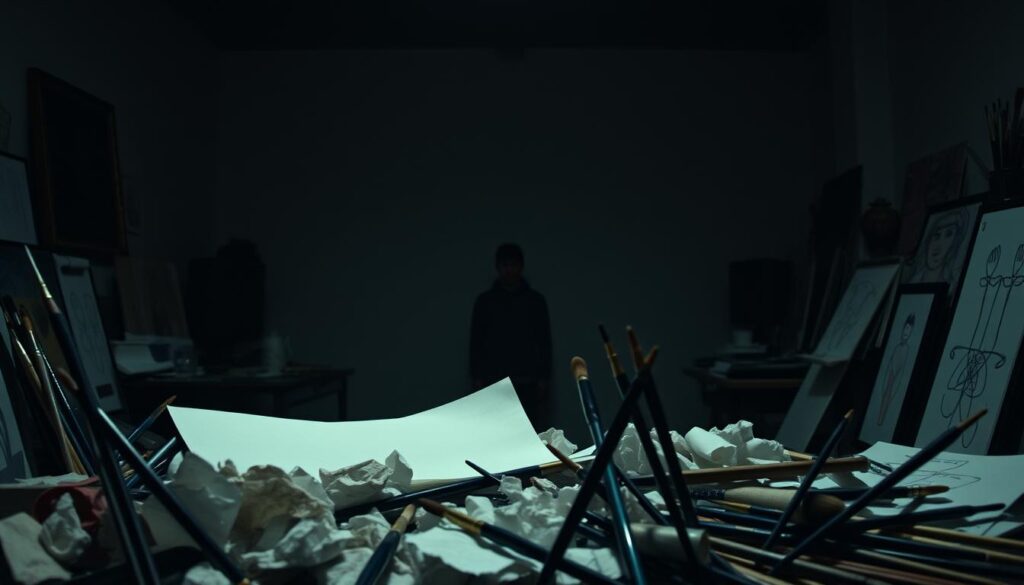
We’ve all been there – staring at a blank page, feeling stuck. Creative blocks can stop us, but we can get past them. Knowing why they happen and how to fix them is key.
Common mental barriers
Our minds can block our creativity. Fear, wanting to be perfect, and doubting ourselves can stop us. As Pablo Picasso said,
“Every child is an artist, the problem is how to remain an artist once we grow up.”
This quote shows we’re all creative at heart. But growing up makes it hard to keep that spark alive.
Identifying your personal creativity stoppers
To beat these blocks, know what holds you back. Think about your feelings when faced with a creative task. Are you scared of not being good enough? Or do you feel too overwhelmed?
Spotting these patterns is the first step to breaking through.
Practical techniques to move past blocks
There are ways to get past creative blocks. Try changing your setting, practicing mindfulness, or working with limits. As Twyla Tharp, a famous choreographer, said,
“Being creative is not a state, it’s a habit.”
Building a creative habit means practicing regularly and being open to new things.
Exercises to restart your creative flow
Try simple things like writing freely, drawing, or brainstorming. The most important thing is to not judge yourself. With practice, you’ll find it easier to come up with new ideas.
The Surprising Benefits of Regular Creative Practice
Doing creative things often can really help your mind and heart. It makes you feel better and live a happier life.
Mental Health Improvements
Creative stuff is good for your mind. It helps lower stress and anxiety a lot.
Problem-Solving in Other Areas of Life
Being creative helps solve problems in other parts of life. It makes you think differently.
Building Resilience Through Creative Thinking
Creativity makes you strong. It teaches you to try new things and solve problems.
Adapting to Life’s Uncertainties with Creativity
Being creative helps you deal with life’s ups and downs. It makes you more resilient and happy.
Your Creative Journey Starts Now
Being creative is a journey, not just a goal. We’ve seen that creativity is for everyone, not just some. It’s about using our minds to find new ways to do things.
Steve Jobs said, “Creativity is just intelligence having fun.” This means we can solve problems in new ways and enjoy the process. Creativity helps us grow and feel happy, whether we’re making art, solving puzzles, or starting a business.
So, start today. Do things that make you curious and excited. This way, you’ll use your creativity and help make the world a more interesting place.
Leave a Reply